Friday, 1 June 2012

Syria: part II

Twitter tells me that 'bloggers are uniting' today, to condemn the Houla massacre in Syria and demand a response. I'm using my lunchbreak.
(Twitter also says it's doughnut day; twitter is very strange).

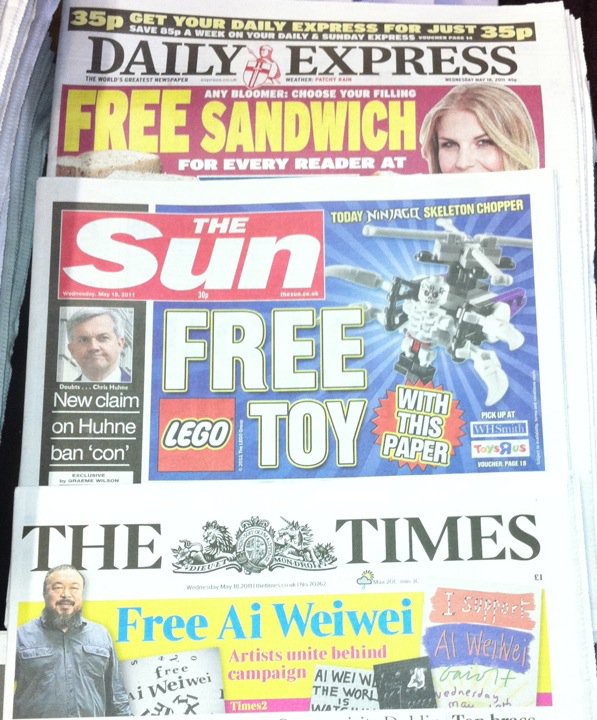
The Times has made this article free to access on the massacre: "The children of Houla were not killed by random shelling. The UN yesterday revealed that they were murdered one by one."

I've met Syrians in London who knew those attacked by the regime as well as inexplicable Assad-supporters (described as 'brainwashed' 'mad' or 'sharing in the corruption'). The first time I was aware of how terrible Assad's abuses had become was in conversation with a Libyan doctor this winter. At that time, Syria was 'the forgotten place', but she was getting emails about doctors being murdered because they were 'treating from both sides' including injured protestors.

Another friend lived in Damascus before 2010, when goons visited foreign students to let them know they were under surveillance. Long before the killings, but it was obvious that the fingers of the state went everywhere, with impunity.

This week I met protestors outside Syria's London embassy, calling for Assad's flag to be taken down and replaced with the green flag of independence.

Here is a picture showing the distance between the protestors and the objectionable flag:


The people also wanted to be photographed, obviously... But I don't want to publish the photos here as anybody can look at them and apparatchiks run all over the world.

There were about 20 protestors when I got there. They explained that British police are 'very polite' and that they are not allowed to remove the red-striped flag and replace it with green.

I got talking to a man who explained his feelings to me:

"Yesterday I lost my cousin. Yesterday, just yesterday.

"Because if you go just outside the home, and go to protest some snipers are everywhere, all over the building, government building and shooting the people, randomly."

Where was he?

"I am from Homs. He is from Homs, inside Homs.

"I am from the same city of Homs, not from town or countryside. But now Homs, many areas inside Homs, the same area, all the time, bombing, shelling, using tanks, snipers. Like war. Lots of trouble, trouble."

What did your cousin do? What was his work?

"Why? Just protest. Peacefully, peacefully. We have a lot of stories. If they're going inside the homes killing children by knives, what do you think? They never, they never ever want to give up because they know if they give up many people will get their money and they will go to criminal court. That’s why they’re going to stay and control that country and fight, fight fight fight until the last person. It’s very difficult. People are now asking for a no fly but I didn’t hear any country saying, we cannot do that. It’s very bad."

He said. "I wrote this –"


And showed me pictures that his cousin took of happy, smiling gatherings: "We have hope."

Saturday, 28 April 2012

Pussy Riot: an aesthetic protest

Did you hear about the band that embarrassed Putin by singing songs about him being a chicken in Red Square?

Pussy Riot is a fairly unique protest movement that has sprung up in Russia, although these protestors I spoke to recently, returning from a dance-off in front of the Embassy in London, said that it is more popular abroad because the level of repression they face in Russia is so formidable.


The three women whose photographs they're holding are alleged to belong to 'pussy riot' and are currently jailed with their lawyer fighting for their release.

The arrests ostensibly resulted from an 'illegal' gig in a church in which they prayed to the Virgin Mary to deliver them from Putin. Just looks like a nice party to me:


But the activists I spoke to feel this was just an excuse, and the most important protests Pussy Riot did were in February, in Red Square. They explained that Pussy Riot (and I would stress that the imprisoned girls, pictured, are only ALLEGEDLY from Pussy Riot) are "Politzeki: political fighters, for freedom of the culture".


I asked if this is mostly a feminist movement?

He said 'it's full of all kinds of people'.

The girl on the left explained: "It's more often led by feminist ideas, for [the girls who held a gig in a church], because they stood for eligibility and for feminism - they are really amazing in that way. It's one of the reasons for why they are mistreated. But in Russia  you would see all the different people for different groups."

I knew that these three pussy riot members had been imprisoned for a gig they held in a church, but asked how they could be identified, given that band members wear neon balaclavas?

The girl on the right said: "They can't prove anything! They say maybe they were identified from their mouths, but they can't prove it. I think everybody has just accepted that those three girls are the girls in the church."

The man (middle) said: "I think they [the government] were just waiting for another moment for Pussy Riot, to arrest them. Because actually, my theory is that he [Putin] wanted them arrested after they went to Red Square in February.

"In February they went to Red Square, in front of the Kremlin, and sang a song that went: 'Chicken-coward, get from the Kremlin, you have to go'. So he wanted to get to them directly, to get rid of them, but he couldn't, because he will look like he is a weak person - that he is afraid of the song."

"Because of the elections you know," one said "he couldn't arrest them at this time."


They showed me these pictures of other activists who have been arrested.

This month, reportedly 13 activists were also detained outside the courtroom where the three women were trialled.

For background, I like Peter Savodnik's summary in BusinessWeek:

'The rise of Pussy Riot is but one of many recent manifestations of public disapproval of the Kremlin. Discontent had been building for more than a year when demonstrations erupted in December after legislative elections whose results the authorities had clearly tampered with; widespread anger spearheaded by Russia’s youth focused on the United Russia party and its leader, Putin. Alexey Navalny, the most prominent opposition leader, is just 35. Among the more visible protest factions is FEMEN—which, like Pussy Riot, is an all-girl group that uses shock value to protest the regime. Unlike the punk-rock ensemble, members of FEMEN are known for taking off their tops and screaming angry, anti-Kremlin chants.
[...]  Punk rock icon Kathleen Hanna, who posted a video online voicing support for Pussy Riot, said: “These are the punk rock feminists that would be our friends if they lived down the corner, up the block, in our neighborhood, around Bushwick—wherever. These would be the cool girls we hung out with.”'


Monday, 2 April 2012

Syria


This blog entry includes accounts, roughly-rendered, from Syrians and other activists I know, along with what I've seen outside the embassy in London...

 I first noted this when friends spoke about an activist who was killed, and I lay awake afterwards in tears, bombed by the story.

However it has taken a while to re-upload this while I run it by the people involved - as they know their story best...

Free Syria: notes

"Everybody loved him,” she said. “He was a beautiful person - not just in the person that he was, but also, physically, beautiful. I couldn't understand how anybody could do this to anybody, especially to somebody like him, but they did.

“They tortured him. They smashed in his skull and they killed him, and they- "

She put her hands to her face and moved them around- a gesture to convey what had happened to his face.

There are still voices, internationally, defending Assad's regime.
I’ve seen them outside the Syrian embassy in London. Every time the ‘free Syria’ activists have a protest, the pro-Assad people set up camp on the other side of the square.


Here are the anti-Assad group, 'Free Syria':


The Free Syria protestors have angry speeches from guests in English and Arabic, while the pro-Assad crowd jump up and down singing love songs, with their dictator gazing pathetically from the tops of flag-poles: duplications of Assad’s-puppy-gaze and Assad’s straight little mouth.

'What on earth are they celebrating?' we asked.

'Being in power, of course,' observed a friend.

We watched them bobbing up and down frantically and wondered if they were all relatives of the royal family.

The hands of dictatorship reach out everywhere, but especially in London (see Kelvin Brown's blog - 'robbed at the gaddafi's london mansion', March 22, for more of this madness).
.......................................................................

M, an activist I met, knows all about Assad's apologists. She said: "I understand how a Jewish person feels if they are faced with holocaust deniers.

'I was at a lecture, the speaker was talking to us about the French Revolution and she said 'what do you think of Syria?'

"I sat up - I thought, yes! Syria! Of course they had no way of knowing that I am Syrian. But, one Algerian guy stood up and said 'I think it's bullshit'.

"I said: but you have seen the pictures of children killed?

He said, yes, but that these are all terrorists, and that we are all selaphists in Syria.

I said 'look at me, I am Syrian, I am with this revolution and I am not veiled.’ This guy was so aggressive, he argued with me for so long, I just couldn’t stand it.”

She glanced at the floor. “I completely broke down."

Her Egyptian friend, L, interrupted, gently: "the French and the Algerians do not want a revolution to happen in their own country. This is why they are so aggressive - because they are scared."

M said: "Some people try to argue with me about numbers - they say, ah, you think it is however many thousands of deaths it is more like 300 that he is responsible for, or something like that.

Even if you could only prove that Assad was behind 1000 deaths, 100 deaths, even if it was 10 deaths, or just one - you can't put a measure on pain."

She went on: "I can even count four Syrians that I know, here in London, who do not oppose Assad. And in Syria, too. The more people watch the television, the less they seem to actually know.
“Even in Homs,” she explained, “there is a wall. Inside the wall, you’ll see boys on the street, girls, wandering about, talking - you could think that everything is fine. Outside it...”

She makes another gesture to indicate buildings razed to the ground.

"... You know,” she carried on, “I even went to Tunisia and I had a bad feeling. I wasn't expecting it. A few years ago, I had been absolutely moved by the warmth of the Tunisian people, but I went there last December and...

"We said: we are Syrians. And they said: Yes." She did an impression of them shrugging. "We think - is that all you're going to say?! And they say: your revolution is quite different to ours. I say, yes. It is different. Ours is very, very much more feeling. Very real to us still. What happened in Tunisia was such an inspiration to us and they do not even..."

She broke off with restrained sadness.

L said: “I spend so much time thinking to myself: what am I doing about this, other than praying?”

M said “You are raising awareness. When I speak to British people they realise that I am somebody young, educated, maybe stylish? Someone that they can have laugh with. Somebody just like them. That we are peers.”

The group spoke about somebody that they had all worked to free from Assad's forces, a Syrian student at a university in London:

“When he was captured, my brother said to me ‘are you sure you want to speak out?’ but I just thought of him, trapped, and of course I had to do it. I knew what could happen to me, but there was no question in my mind.”

"I will say," said N, an English girl, "that I am such a coward. But, I saw an Afghan woman MP speaking on television, answering the question 'and what if you are killed? What about your children?' - she just [smiling] said 'we all die, anyway.' I was so inspired by this woman.

'We all spend our lives fearing death - but in this world, I feel we have lost touch with that, and we extend it until we fear the loss of our office, the loss of our title, or job.

'Will we get so scared that we can no longer leave the house?'

She went on to explain what I've always believed, that heartlessness only comes from a sense of detachment from suffering:

She said: "I saw a girl on TV speaking from Syria. She said her father had heard a knock on the door.

And she said - don’t open it.

He said: No, I will open it, I’ve done nothing wrong.

But when he opened the door, she said, they grabbed him and they dragged him out of the door, and they slit his throat.

People can say oh, it is Syria. But when I imagine that this is my father, and my house,suddenly-”

We all stop for a moment. Then she carries on.

“What really makes me angry is the thought of anybody doing these things to preserve their little office, their little job."

L said: "It’s power. I have seen people change the moment they get a taste of it."

"I know 'absolute power corrupts absolutely' - but, Assad could have listened to the protests. He could have made his government more democratic and still kept his piece of power. Now that he has done this, people want him dead."

L said: "What will happen when Assad meets God?"

“The shit that will go down when that happens."

Monday, 5 March 2012

Spring: Libya; Egypt

"You've got to learn Arabic."

This advice came from a surfer-journalist with volcanic qualities, who'd found out I was interested in 'the Arab spring.'

"You've got to learn Arabic," he said. "You've got to study thousands of years of history before you can begin to understand. And you've got to tell the truth, although it won't get you very far."

Admittedly I've not learned Arabic yet, but I'm increasingly fascinated by the changes taking place across the Middle East and North Africa because we can talk all we like about 'political' revolution or a revolution of 'ideas', but I'm beginning to feel that what happens next could be made or broken by...

1) Guns
2) Money

So let's continue on this note.

Egypt

I have no unifying narrative for such a densely-populated country, but it's come to my attention that the UK is waving a £100,000,000 bill at Egypt but has not disclosed what the debt is made up of.

E.g. 'Here is a huge bill. Please pay it.'
'What are you billing me for?'
'Um...'

A question that this group are working on and if you're interested there's a meeting at the Grayston Centre in London on Thursday.


While debt saddles the economy, it's notable that $1.3 billion USAid per annum and the guns in Egypt are owned by SCAF, the Supreme Council of the Armed Forces, leaving Egyptian activists concerned that military power could override any elected government. One family have been yelling about this very thing outside the Egyptian embassy every day for more than a year now, and told me that their house in London is being watched.

Libya

My understanding is that citizen hoarding of both guns and money is widespread, but there have been some striking *dams* in the flow of money during transition.

I attended a lecture at SOAS where the Libyan ambassador to UAE said that there is now a 'multitude of voices', as opposed to *one voice* (the State's).

This was echoed by a UK-based Libyan (with close connections to the freedom fighters) who claimed to me:

"Every day there is a fight, every day there is an argument and people die because of clashes between different people and because what we called the fifth column, the Gaddafi groups infiltrating everything and causing problems between the different freedom fighter groups.

"They are getting what we call the electronic army, they are invading our Facebook websites. They are invading everything and anyone who stands up to them, they will ruin his reputation by accusing him of stealing or of being with the regime."
I also heard that the people working for the revolution hadn't been paid in months - and that the people running the country had been paid, or hadn't been paid, depending on who you speak to. It was only much later on that word of a cash shortage emerged from the haze.

The latest Exaro article:

I interviewed the Libyan transitional government's former health minister, Dr Nagi Barakat for Exaro News (my investigative journalistic employer). Despite Libya being an oil-rich country, he claimed to have no formal budget during transition.

This was, he said, partly due to their being 'no cash' (meaning 'actual, physical cash') in Libya, partly due to corruption, and partly due to money being located outside the country.

We're talking about the period from March to the end of November last year and among other things, I'm now looking at whether the problem is ongoing.

Tuesday, 10 January 2012

What was Mubarak's finance minister doing at the London School of Economics?

Today (well, yesterday - it's late) - I was startled to see news unfolding in front of me at this LSE public lecture: "The Year of Egypt's Second Revolution, the balance sheet so far"

The lesson being: stay for the public questions, they're the best bit.

A girl to the left of the hall put up her hand to say something like: "I've been finding it difficult to concentrate on your lecture because Egypt's ex-finance minister is sitting in this room. How can he be sitting here - after so many people have died - when he is wanted by Interpol - how can he be sitting here in this audience?"

The audience peered around. Youssef Boutros-Ghali was in the room but he must've managed not to blush because at first, nobody was pointing him out. But he was - oh, definitely there. A few people clattered up the stairs at the back of the hall - I later learned that they'd stationed themselves at doorways, trying to arrange his arrest, but they met with resistance from LSE security who said that they had to respond to the 'threat' using the information they had available at the time.

But for those who wanted to confront him it was an electric discovery. "He's not that hard to recognise!"a group of them piped to me after the event. "We can't believe he's gone."

One of them rounded on me. "What's your take on this?"

"Um... I find it really funny that he's here. That he came to a lecture at the LSE to learn about the revolution in Egypt."

Somebody observed he could be having an existential crisis: "why am I here? Why has this happened?"

"Doesn't he know enough about the second revolution, that he feels he has to learn about it from a Harvard academic?"

"I wasn't even planning to come here today," she said. "I was trying to decide whether to go eat, or to go to the lecture, and I chose the lecture. He was HERE and now he's gone!"

It turns out Joe Quinn of the Guardian was also there and wrote this piece tonight: 'Anger over appearance of Ex-Egyptian finance minister at LSE lecture'

The Egyptian students' eager attempt at an arrest was thwarted by LSE security rules that give the insitution a 'duty of care' to any member of the audience who feels threatened.

According to Quinn's account, when the university realised that Youssef is wanted by Interpol for "fraud, fraud, fraud" they phoned the police but by this time the ex finance minister had got away in a taxi.


Now, in some ways it's not surprising that Boutros-Ghali was not only ushered quietly out under protection but treated with enormous respect within the lecture theatre itself, with the person alongside me whispering 'this is so inappropriate' when further questions mentioned the finance minister. Officialdom - even fugitive officialdom - has a tenacious quality of commanding respect.

Afterwards, protestors chanted 'shame on you! Shame on you' in the lobby of the New Academic Building while flustered security explained that he'd had limited information and a duty of care to all audience members and would behave in the same way if any member of the audience had been under such a threat. One of the students said that she was shocked by what was considered a threat and had been told by security that she couldn't stand outside with her phone ready to take a picture.

"If you felt intimidated by security at any time, I am sorry, we will address it."

"You acted to protect him from students," she said.
It reminded me of one of the historical revolutions cited during the lecture.

When the revolutionaries won, they walked among "the people" and found they were heckled and mobbed.

Twelve months later, they spoke from a podium and the people were not allowed anywhere near them. This was to be an authoritarian government.

The point made in the lecture is that every revolution is a "people's" revolution and afterwards, anything could happen. Professor Owen argued that we need to take an interest in the 'nuts and bolts' of a democracy because elections alone are never enough for democracy to function. In every revolution there is what he calls a 'military interest', but the definition could be broader, jockeying for position with other forces, seeking absolute power and protection from scrutiny.

Thursday, 17 November 2011

Legal reform: a report and a rant

Hello hello,

I'm a reporter for Exaro News now - which is brilliant. Here's some work:

Reforms lead to 'financial hardship' for barristers

And here's a supplementary rant ;)

This year has seen a lot of cuts to legal aid (with more to come) but the one most bothering me is a cut that financially penalises lawyers who defend a client that opts for Crown court before pleading guilty.

Late guilty pleas are commonplace - 70% of crown court cases end in a guilty plea, and 95% of Crown court criminal cases are legally aided - so that's quite a lot of Crown Court cases where a lawyer could now lose money, right?

Firstly:
I'm worried by the idea that a lawyer's pay should hinge on how a client pleads at all, as everybody is entitled to a defence, guilty or innocent.

Secondly:
The fixed fee seems punitive. It's just over £200 for advocacy, which barely covers a couple of days work, as chambers rent isn't cheap. Could this be a cynical attempt to stop lawyers working in criminal defence at all? If so, it's working. Criminal barristers are having to diversify.


So, how did this change come about?

The idea was slipped into a green paper (proposals for the reform of legal aid, etc etc), one year ago. Almost everybody objected to it. Judges were unitedly opposed. Young legal aid lawyers feared for the future...

The guilty plea fixed fee was nevertheless implemented last month - £203 for advocacy, £362 for litigation.

A QC told me that thanks to lawyers' and judges' objections having been ignored, he's concluded we live in a 'sham democracy'.

(On the note of sham democracies, I welcome VentnorBlog's report that last week the Isle of Wight Council have lost their High Court case regarding their Adult Social Care policy. I was writing about their failure to engage with service users in 2010).

I've not finished my rant yet. :)

The fixed fee is only waived if the lawyers have considered more than 10,000 pages of evidence.
One barrister told me: "There are up to four appearances in each court before a guilty plea. If you are served with 9,800 pages of evidence you will still be paid just over £200 in all. It's absolutely ludicrous and will kill the bar."


And, I could go on.... But instead of that, will show you the judges' and lawyers' objections for posterity. This cut has been wheeled in, anyhow.

But if you get into trouble and wonder why can't find a criminal barrister who'll go to Crown court with you - this might be why...

Young Legal Aid Lawyers warned:
There are two principal problems with [the fixed 'guilty plea' fee across both courts]. The first is a practical problem. Under the profession's Codes of Conduct and ethics in general, no lawyer should put pressure on their clients to stay in the Magistrates’ Court and to plead guilty early. It would be completely inappropriate if they did: lawyers should not be placing pressure on their clients to plead guilty to further their own financial interests.
[...]
The second problem is a constitutional one. Effectively the Government is using legal aid as a means to pressure defendants into choosing a trial in the Magistrates’ Court. However, the right of a person to elect trial by jury in the Crown Court is a fundamental and well-established part of our democracy. The previous Labour government controversially proposed to abolish a defendant's right to choose jury trial in 1998. This was later withdrawn following political opposition.
This government is effectively re-introducing the abolition of the right to choose jury trial by the backdoor, for financial reasons. The proposals disregard this important constitutional principal. If the government wishes to remove the right to trial by jury then this should be done openly after a proper debate rather than discouraging poorer citizens from exercising this right through the manipulation of legal aid funding.
 Council of Her Majesty's Circuit Judges (COCJ) said:

We do not agree with the proposals.
We agree that it is desirable that where possible a case should be dealt with in the Magistrates Courts rather than in the Crown Court. [...] We do not accept, however, that the proposals are based on sound propositions which will provide either a fair or an appropriate level of remuneration.
The proposals proceed upon the basis that the magistrates and lawyers representing an accused have the dominant roles in the decision as to which court will deal with the case. They do not. It must be remembered that the role of the defendant is fundamental to the determination of the venue of the case. The law provides for the defendant to have the right to be tried by a jury. If the Magistrates accept jurisdiction, it is only if he consents that he may be tried by the Magistrates. The accused is also advised of their power of committal for sentence.
[...] the lawyer has to base his advice on the information which is available to him at that time. In many cases this may be very limited. Recent procedures in the Magistrates’ Court system have improved disclosure of the case to be presented by the prosecution but the defendant’s instructions may indicate a clearly triable case. In those circumstances, it is proper to advise of the election for trial: that is the accused's constitutional right. If the government wish to alter that, it should be done openly and after proper consultation.
[...]We further consider that it is unacceptable to link remuneration to an early resolution of the case. We express concern that this may lead to undue pressure being imposed upon an accused person, especially the more vulnerable defendants to plead guilty without proper consideration of the case.

Further the COCJ argued that a guilty plea can result from work on behalf of the lawyers. If you stop remuneration for the work, then the result could be a vicious circle where you see less guilty pleas as lawyers put less effort into preparing a case. More delays; more costs; counterproductive. That's the theory - time will tell:

(BTW: if a client pleads guilty under pressure of Crown evidence, their trial is called a 'cracked trial')
It is often that the reason for the cracked trial is because of the work carried out in the preparation of the case for trial. With that work, it often becomes clear even to the most unwilling defendant, that his defence is flawed. If the value of that work is not properly recognised in the fees payable, there will be a tendency for that preparation not to be carried out or carried out inadequately so that either the trial has to be vacated or worse, a trial is unnecessarily pursued.
The guilty plea often comes as the result of a reassessment of the strengths of the case on both sides. Forensic evidence is often delayed. Transcripts of the recorded evidence of a complainant in a sex case are not prepared until after it becomes known that there is to be a trial. When they are, a proper assessment of the witness’ evidence becomes more readily available. These are examples of the features which may lead to a guilty plea.

*deep breath*...

That is why it worries me.

Over and out.

Tuesday, 5 July 2011

Displacement and good fortune.

Here's my latest piece for TotallyMoney - an interview:

Are squatters criminals? Ask a squatter

In other news… I've been offered a job in journalism.

"Can it be true?" (my mum, freaking out), YES. I can't tell you a huge amount about it yet, as the news platform is completely new, but when we are launched, I'll share my work here…

The timing couldn't be more fortunate! I was displaced recently: For those of you that don't know, I've been one of those dreadful unemployed graduates and a serial intern, trying to "make it" in the capital while crashing at different people's houses. My favourite haunt's been a lovely shed (more like a summerhouse) owned by a friend's parents, who are exactly like old-school heroes in children's novels. They've even got a cat, and a grandfather clock.

The idyll ended for a good long while at 4am last Thursday, when their 20-something son burst back onto the scene from Romania, with two friends. All of their rent had fallen through - the landlord put it up by 30%.

Needless to say I hadn't been expecting them at that hour…

"Argh, sorry," he said. "I didn't think anybody would be in here."

"It's fine it's fine it's fine…" I staggered out of bed, wide awake all of a sudden. He retreated back to the house, but the birds were already singing. I bundled everything into a beach-bag, preparing to head to my sister's sofa, feeling a bit homeless.

… But now I have a job. *Beams*. One of the side-effects of being happy is that more people talk to me, including a massive bloke who squashed in beside me on the bus yesterday with an iced drink. He sucked through a straw and the cup gurgled. We exchanged one of these 'well, this is awkward,' smiles.

"Want some?" he said

"I'm OK thank you."

"Are you sure? There are two straws…"

Ah no, no thankyou.

"Just making conversation. How are you?"

"I'm OK." I contemplated telling him all about my life, and why not… "I've got a job!"

"Really?"

"I've been unemployed for a year, so, it's pretty cool."

"And how are you feeling?"

"Tired."

He asked me if there's anything that I've written that he would've read. I said probably not, but told him about Tim Minchin anyway, (I tell everybody about Tim Minchin).

"And what do you do?"

It turns out that this guy is a youth worker, performer, and ex-offender.

"Wow! That's really interesting." I beamed, although I stopped short of asking him what he was inside for. I love traversing London with former criminals? This sort of thing should happen more often.

It could, actually, because he gave me his card and his youth work looks interesting. Check it out.

Also, Sleater-Kinney:

Monday, 6 June 2011

Poppy; Perlin; print journalism

Hello there, it's been more than a month hasn't it…

First things first

Did you know the Poppy Project, which gives shelter to trafficked women, is under threat because its funding has been cut? This is almost as worrying to me as Mark Townsend's piece about the lack of protection for trafficked children.

As it happens, I know a woman who was trafficked. I didn't remotely suspect it, but one day she admitted to me that she couldn't read English - she looked upset. I offered her reading lessons and in the course of an evening she told me her history.

She'd been packed around the world from Thailand, confined for nine years with other domestics. It was bad in New Zealand, she said, but it was much worse in Britain.

Because once they were in England, they weren't allowed to do their own shopping - they were hidden in a house, forbidden from going out. Sometimes they were only given floor cleaning products to wash themselves with. The men in charge were cruel. They had her passport and her papers; they used these things to control her.

She escaped, eventually, when a woman befriended her from the outside, but she still feels trapped sometimes and she still knows when snake-head gangs are nearby - she can feel it.

She gave me two huge servings of roast chicken, a hug and showed me how to write words in Thai.

Save Poppy.

And as to me…

I'm up to my elbows in job applications, helping out Eat Me food and culture magazine and blogging for Totally Money dot com, a handy little part-timer. Here's one entry I'm particularly pleased with:

Tips on surviving unpaid internships.

I've picked up a copy of Jilted Generation and am looking forward to reading it… I've also become a fan of Ross Perlin having seen him speak at Hackney Pages on Tuesday.  Intern Nation's the obvious thing to check out by him, but I also rate this piece he did last year for Lapham's quarterly, Riding the Godless Express:
For the atheist pilgrim there are no shrines, no temples, and no holy relics. He might glimpse a godless Genesis in the suburbs of Geneva, where particles race and clash in the tunnels of the Hadron Collider. The Great Rift Valley might feel like coming home, if he knew where to look. Perhaps he could visit the shores of Libya, where Theodorus the Atheist first challenged Zeus—or the German town of Naumburg, where Nietzsche took the pulse of God and found it stopped…
Quite poetic, isn't it.

Time for a random picture:
(Mmm, chocolate)

Besides writing about internships, and how to have cheap fun in London, I've mostly been writing about food. :) See Issue 5 of Eat Me food and culture magazine. It's very good. You should buy it online or in WHSmith for £4:


I particularly enjoyed the cover interview with Ainsley Harriott, a man as warm as he is tall.

I would also like to thank these people for stellar work:

Photographers
Alexander Missen, Reynaldo Ortiz, Lauren Mclean and Oscar May

Writers
Timothy Franklin, Sam Kinchin-Smith, Sam Bompas, Florence Hillier, Dominique Hopgood

Artists
Juliana Wang, Lydia Crook


On a final note

It's a strange, unsettling world. China's prisons are being used for MMO gold farming.

Here's something my dad spotted last month when he went out shopping:


Sunday, 20 March 2011

Food and folk

This blog has been quiet for a while, because I launched myself into work on Issue 5 of Eat Me magazine.

I took on Food and Culture editorship at the end of January, was deliciously deluged with tasks and the fruits of my labour will be on the shelves later this Spring. Until I actually see the magazine and have it in my hands, I don't think I will fully believe it, so am nervous about giving an exact date.

Incidentally, the new website mentioned on that link is in development currently. I am writing and commissioning articles and recipes for it! And it will launch again very soon.

Have I mentioned before that I love food? Before moving on with this blog post I should perhaps share tips, some gained on the magazine, others prior to it:

A mouthful of advice…

Avocados. Just, eat them, mash them up, use them as an ingredient; they're great.

Coconut milk is wasted uncooked but an excellent base for boiling pretty much anything.

An electronic spice-grinder can also be used for nuts, and this is good for devising gluten-free, milk-free, egg-free fruitcakes. I discovered this when I had a housemate allergic to wheat, milk and eggs…

Passion fruit with sugar is a good quick dip for drop scones. 

The Apple Charlotte recipe in this book is even better if you add raspberries.

This dessert wine is delicious.


Foodie aside satisfactory? Good. On to the next thing!

I have some music to recommend

Mid-February, I wrote but didn't publish a music review I wanted to submit to a wonderful blog called For Folk's Sake. My attempt at a deadline failed largely because I worked on it in a pub close to the venue. As I scrutinised which picture I should attach, a Man-U game started, a crowd of red-and-white-clad fans dislodged me from my seat and my article fell by the wayside. I will use artistic license and blame football hooliganism.

I hope you enjoy it though.

This is the Kit + Michael Wookey @ Union Chapel 12.02.2011

Union Chapel is my favourite folk venue. They sell delicious quiche and homemade brownies (on this particular day, the seller seems to make his mind up how much they cost on the spot), and they host some really interesting artists as part of the Arctic Circle gig events called ‘Daylight Music’.

Folk gigs can be tedious. I don’t have a lot of time for soppy, safe artists lacking a sense of humour or a willingness to subvert ye olde tradition.

I do however have time for Michael Wookey,whose banjo has a sticker on it politely stating ‘Yes, I am Mormon.


“Hello,” he says, shyly. “My name’s Michael…” The pews nod and smile back at him. His microphone emits a sudden BANG! And he jumps.

“Fu- I meaaaaan… Sh-ooooot… Sorry God… Sorry…” he whispers. “I feel really bad now.”

Michael’s first song alienates me slightly with its David Grayish aspect – how many boys these days can rattle out the same old romantic sentiments, grimacing slightly, with their eyes closed?

But I’m won over by his creative instrumentation and his slightly playful boyish demeanour (he has a rainbow pin badge and a military-style red jacket like you’d find in an antique fancy dress box). His charm is clearly amplified by a large collection of toys: A table harp, a calculator synthesiser, a toy piano that chimes to the touch, a large metal music box, which he’s made himself:


Most fascinating, however, is an antique Salvation Army pump organ that folds, delightfully, into an old battered suitcase:


The organ's woodwork creaks with genuine age, having been inherited from his grandfather when Michael was 15. It has a history in the fields of war.

Overall, though his set ranges freely across historic inventions and could be described as VINTAGE-FUSION. Cameos of aged toys are interspersed with synthesiser sonatas. He's even bodged together one of these synthesisers himself and a mess of wires extend from one end. What a polymath.

His unique blend of angst and wonderment is a hard act to follow for a comparatively kook-less band called The 99 Call. They are very nice, but I don't feel an urge to shout about them. Given that this is my blog, I won’t, but listen to them, by all means.

For me, the real treat of a set comes from This Is The Kit.

“This song is called waterproof,” Kate Stables says “and we will dedicate it to the roof.” Her gaze wanders between the stained glass windows as she sings in bell-like tones, at home in surroundings that yawn with numinous light.

These folk songs, with pared down melodies and a slightly Celtish aspect to the vocals, really fly in the reverent air of the chapel. They remind me, too, of solitary walks, the sound of the wind on a hillside, and the fact that the stones of this building were extracted from the Earth.

I don’t think you'll want me to blather on further about the poetry of the performance. This is the Kit are ethereally charming. Again, a clip of this performance is YouTubed, much as my camera doesn't do it justice… But if that doesn't satisfy your curiosity, this is their MySpace.  

Friday, 21 January 2011

Internship notes: Jools Holland's loves and hates

I first encountered Jools Holland when I was a small child and therefore perceived him as a tall man dressed in black, outside Blackheath Conservertoire of Music, accompanied by a little boy who shared my sisters' drum teacher. Our paths would occasionally cross.

My dad would say: "That's Jools Holland."

This meant nothing to me at the time, but when I got older I became a devotee of Later With Jools Holland, recognising that a great pianist was introducing a wider variety of artists than those I'd seen on other music shows.

His set-up has a relatively intimate feel, which might be why Later has featured some of the most affecting televised performances I've ever seen.

Adele, for example


I'm not usually a fan of ballads, as they aren't very socially responsible. What if Adele's sobbing, lonely, pyjama-clad fans followed her example and loomed at the object of their heartbreak suddenly out of the darkness?

He
Why are you here
out of the blue, uninvited 
in your pyjamas 
in the night
outside my window 
with gin?

She
 I couldn't stay away
I couldn't fight it.
I thought you'd see my face
and that you'd be reminded
that for me, it isn't over.

What would happen next? Please try it and tell me. The internet needs to know.

Adele singing on Later is amazing, though, and makes me cry. If it doesn't move you, then your soul is gone, man. So gone, that it will create an anti-soul black hole and soon, you are going to turn inside out under the pressure and become an ethereal hoover, blasting noise out of one end and sucking the whole fabric of meaningful existence into the other.

Divas and crooners would no longer exist. Lovers would have to make do with DJ Otzi, circa 2002. Remember him?


[The Anti-Jools?]

What I'm basically saying is if Adele's voice leaves you cold, it's a serious matter and you need to get an exorcist. ’Nuff said?

My review of me interviewing Jools Holland

The conversation proceeded briskly. The words 'brisk' and 'proceed' and also 'hootenanny' capture Jools I think. His answers were off-kilter (I laughed a lot) and he speaks much, much faster than eighty words a minute, as I realised when I transcribed the interview.

He was effusive and witty discussing his Loves and noticeably uncomfortable when I got to the tail end of his 'Hates', insisting that he didn't hate anything really, so trying to come up with a fifth, unique thing that annoyed him was tricky.

Were there any places he didn't like?

No… in fact he likes most places, most objects, most animals, most kinds of clothing, all kinds of music and most experiences…

'Nose pokers,' he announced triumphantly. 'People who poke their noses into other people's business.'

'Can you be more specific?' I needed something that could be illustrated…

He ummed and ahhed. 'They know who they are.'

Did he mean journalists? I asked, being a total nose-poker at this juncture, so he narrowed it down.

I was most pleased to be recommended some music. I've since checked out the Unthanks Sisters and Imelda May and will leave you with Imelda appearing for the first time on his show:


Also, the finished article: